

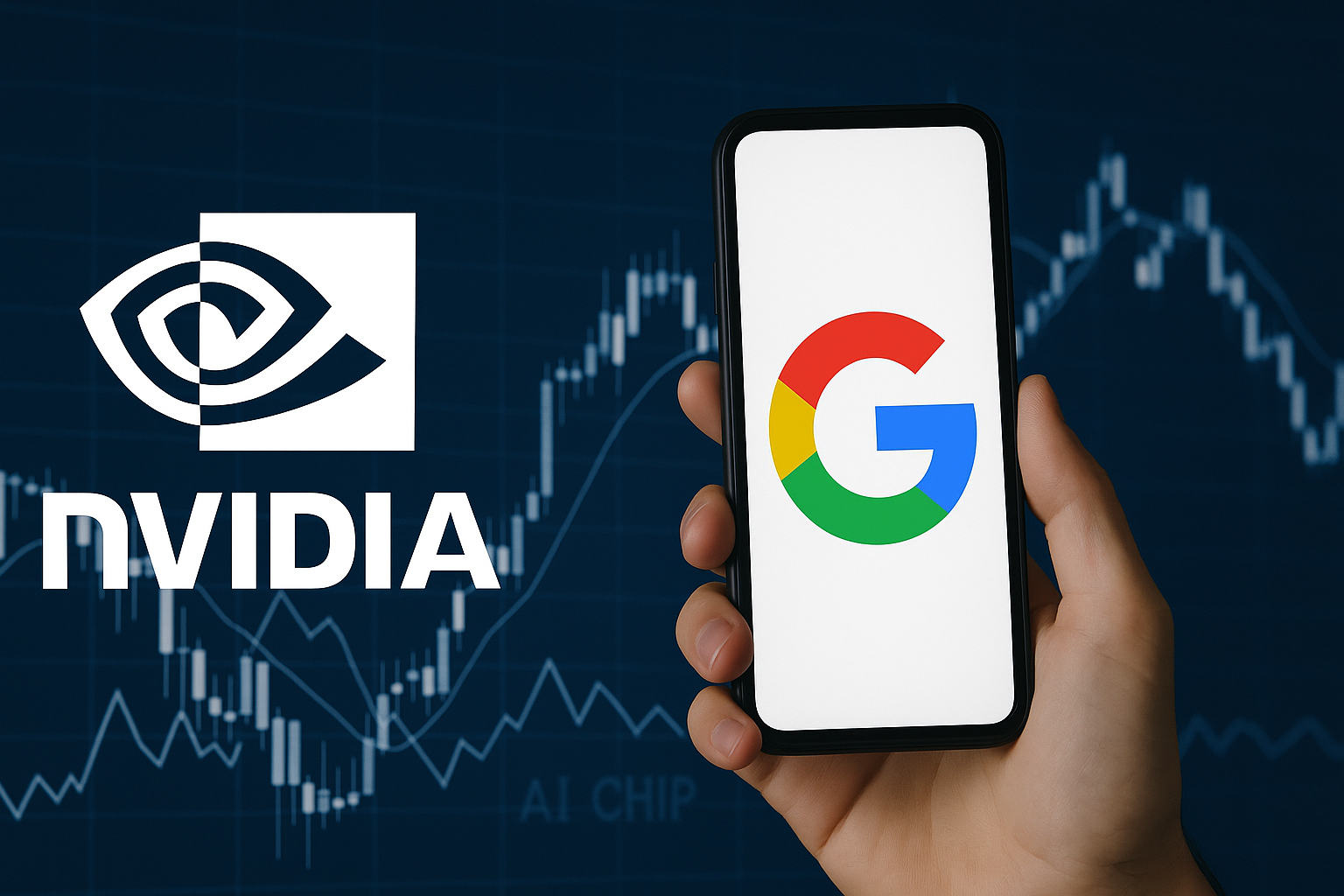
For most of the AI boom, Nvidia has looked untouchable. Its GPUs power the largest language models, its software stack is the industry standard, and its market value has eclipsed entire stock indexes. So when Meta was reported to be negotiating a multi-billion-dollar deal for Google’s custom AI chips, investors paid attention. When Nvidia then issued a rare public statement about the news, some wondered if the champion had finally started to flinch.
The article that set the tone, published by Investors Observer under the headline “Nvidia panics? Rare statement triggers selloff as Meta turns to Google’s TPUs,” captured how unusual the moment felt on Wall Street: a market leader breaking its silence to reassure investors after one of its biggest customers flirted with an alternative supplier.
Meta, Google and a Multi-Billion-Dollar TPU Deal
The trigger was a report in The Information, echoed across financial media, that Meta is in talks with Google to rent and eventually buy Tensor Processing Units (TPUs) — Google’s in-house accelerators for AI workloads. The negotiations reportedly include renting TPU capacity through Google Cloud as early as 2026, followed by on-premise deployments that could be worth billions of dollars.
On the surface, this is classic diversification. Hyperscalers like Meta want multiple chip suppliers to manage costs, secure capacity and avoid over-reliance on any one vendor. But because Nvidia has become the vendor for AI hardware, any hint that a giant customer might push more workloads to rival architectures — in this case, Google TPUs — is enough to shake confidence in its seemingly endless growth runway.
A Rare Statement from Nvidia — and an Immediate Selloff
Companies at Nvidia’s level usually let their numbers speak. That is why what came next stood out. In response to the Meta–Google headlines, Nvidia issued an on-the-record statement saying it was “delighted by Google’s success” and emphasising that it would “continue to supply Google” as well. The company underlined that it remains “a generation ahead of the industry,” a reminder that its GPU platform is still seen as the reference standard for running advanced AI models.
Instead of calming nerves, the statement appeared to confirm that Nvidia felt compelled to defend its position publicly. Traders sold the stock down, with shares slipping as much as mid-single digits on the Meta–Google news and the company’s response. Market commentators like The Kobeissi Letter flagged the statement as a sign that “the AI wars are heating up,” reinforcing the narrative that real competition is finally emerging in a space Nvidia has dominated.
Is Nvidia Really in Trouble?
Underneath the headlines, the fundamentals are more nuanced. Nvidia still controls the vast majority of the high-end AI accelerator market. Its CUDA software ecosystem, developer tools, and installed base across hyperscale data centers give it a moat that goes far beyond raw chip performance. Analysts quoted around the Meta–Google story repeatedly stressed that the company “remains the dominant player” in AI hardware.
What is changing is the shape of that dominance. As Google pushes TPUs harder and other cloud providers invest in their own custom accelerators, big AI buyers now have credible alternatives to compare against Nvidia’s GPUs. That doesn’t mean they’ll abandon Nvidia — it means they can mix architectures, shifting incremental workloads to whatever combination of performance, price and availability makes sense at a given moment.
From a stock-market perspective, that matters. Nvidia’s valuation has been built not just on current demand, but on the expectation that hyperscalers like Meta would keep throwing almost every new AI dollar at its chips. If even a fraction of that spend starts to migrate to TPUs or other in-house solutions, investors have to rethink just how steep Nvidia’s growth curve can be.
The New Reality for Hyperscalers
For Meta, the logic is more straightforward. Training and serving giant AI models is staggeringly expensive. Building a “multi-sourced” hardware strategy — combining Nvidia GPUs with Google TPUs and possibly other accelerators — allows it to negotiate better prices, hedge against supply constraints and align more closely with whichever cloud partners offer the best economics at scale.
Google, for its part, sees TPUs as both a defensive and offensive weapon. Internally, TPUs help reduce dependence on Nvidia for its own workloads. Externally, offering TPU capacity to partners like Meta could capture a slice of spending that might otherwise have gone entirely to Nvidia — some estimates suggest as much as 10% of Nvidia’s annual AI revenue could be at stake if TPU adoption ramps.
Reading Nvidia’s “Panic” the Right Way
So, did Nvidia really panic? The word makes for a strong headline, but the truth is more strategic than emotional. The company’s statement was a calculated attempt to signal confidence, remind markets of its lead, and discourage the idea that one customer’s diversification equals an existential threat.
At the same time, the fact that Nvidia broke character and spoke at all is itself a signal. Market leaders rarely respond to every negative headline. When they do, it’s because they know the narrative — in this case, “the king is finally under attack” — can become self-reinforcing if left unchecked.
For Nowleb readers, the lesson isn’t just about one stock move. It’s about how power is shifting inside the AI stack:
- Cloud giants like Meta and Google are no longer just customers; they’re also chip competitors.
- Investors are starting to price in a world where AI hardware is a multi-player game, not a single-vendor monopoly.
- Even dominant companies must manage stories as carefully as they manage quarterly numbers.
Nvidia is still far from finished. But Meta’s interest in Google TPUs — and Nvidia’s unusually loud response — show that the next phase of the AI boom will be defined not only by bigger models, but by sharper competition in the silicon that powers them.
Leave a Reply