

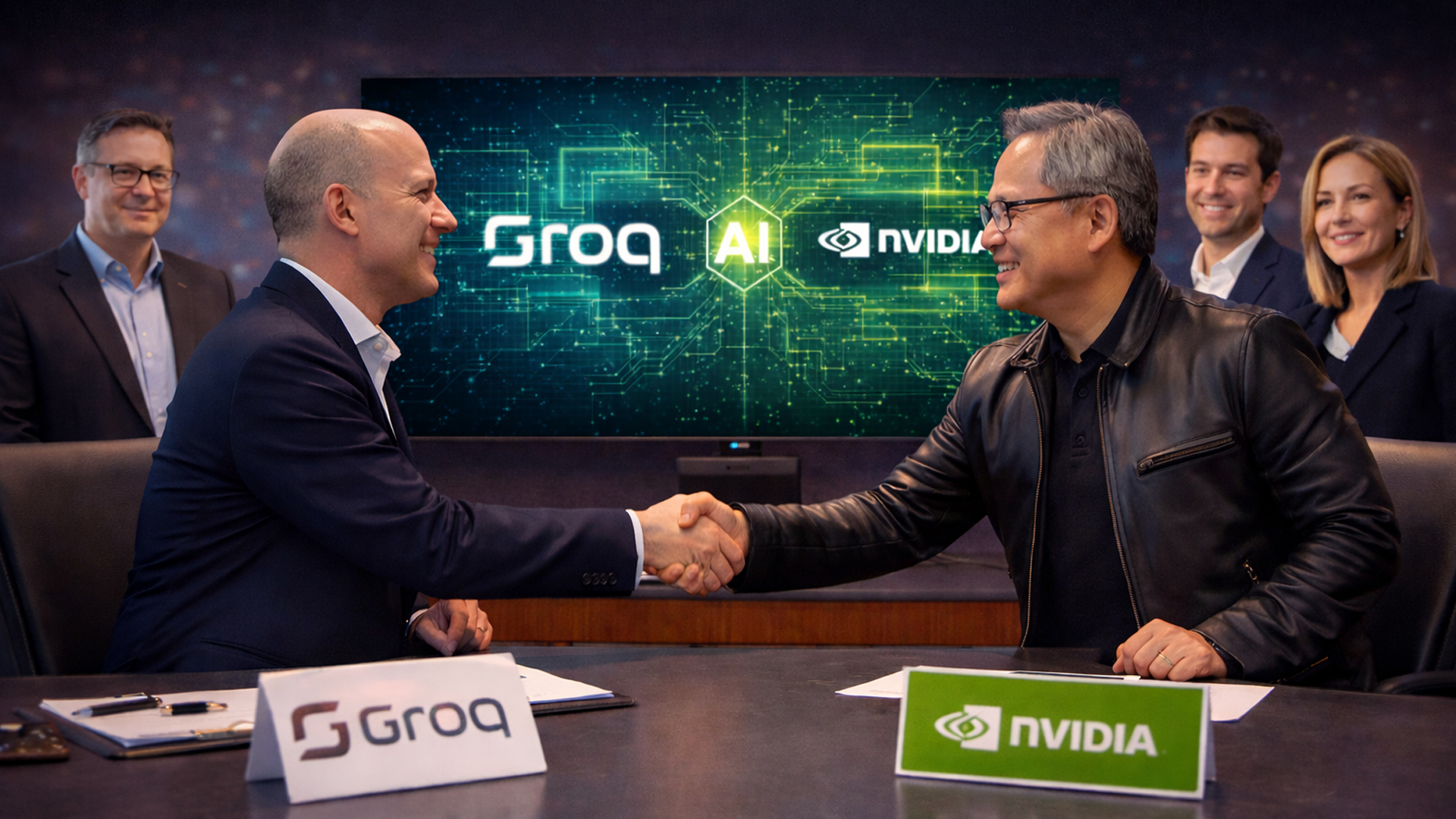
NVIDIA has taken another step to defend its lead in artificial intelligence hardware, signing a nonexclusive licensing deal with AI chip startup Groq and hiring several of its most senior executives, including founder Jonathan Ross and president Sunny Madra. The move strengthens Nvidia’s push into AI inference, even as Groq remains an independent company under a new CEO.
What Nvidia is getting from Groq
Under the agreement, Nvidia will license Groq’s inference chip technology and bring over key leadership and engineering talent. Ross, a former Google engineer who helped launch Google’s internal AI chip program before founding Groq, will join Nvidia alongside Madra and other senior technical staff. Their task: help Nvidia integrate Groq-style high-throughput, low-latency inference ideas into its broader data center and AI platform strategy.
Unlike a full acquisition, the deal is explicitly nonexclusive. Groq keeps operating as a separate company, while Nvidia gains access to specific intellectual property and talent that can be woven into its own next-generation products and software stack.
Groq stays independent, with a new CEO
For Groq, the licensing agreement answers a swirl of rumors. Earlier media reports suggested Nvidia was preparing to buy the startup outright for around 20 billion dollars, which would have been the largest acquisition in Groq’s history. Instead, Groq clarified that it will continue as an independent company, with its cloud business, GroqCloud, still running and CFO Simone Edwards stepping up as the new chief executive officer.
That structure matters. It means Groq can keep positioning its Language Processing Unit and related systems as an alternative to GPU-based inference, while still benefiting from a closer relationship with the dominant player in AI training hardware. For regulators, the nonexclusive licensing model is also easier to accept than a full takeover in a market where concentration is already a concern.
Why inference is the new AI battleground
Most of the early AI investment wave focused on training large models: massive GPU clusters crunching data for weeks to produce systems like GPT-style language models or image generators. Groq’s technology targets the next phase of that lifecycle: inference, the real-time execution of those models for users in chatbots, search, recommendation engines, and other services.
Groq has promoted its chips as an efficient way to deliver huge numbers of inferences per second with predictable latency, using a design that emphasizes chip memory and deterministic execution. In a world where more companies want to deploy AI into production, and cost per query starts to matter as much as raw model size, that message resonates.
By bringing Groq’s founders and senior engineers inside the tent, Nvidia signals that it is not content to dominate training alone. It wants to make sure its platform is also the default choice for the most demanding and cost-sensitive inference workloads, whether that happens through GPUs, new accelerators, or hybrid architectures that combine ideas from both worlds.
A talent grab that fits a bigger pattern
The Nvidia Groq deal also fits a broader pattern across Big Tech. Instead of buying every promising startup outright, companies like Nvidia, Microsoft, Meta, Amazon, and Google are increasingly relying on licensing agreements and “acqui- hire” style talent deals. They gain access to specialized technology and the people who built it, while reducing the chance of triggering a full antitrust review.
In practice, that still reshapes the competitive landscape. When a concentrated group of tech giants can routinely absorb the top engineers and IP from smaller players, it becomes harder for those challengers to grow into true rivals. NVIDIA’s licensing agreement with Groq appears designed to walk that line: Groq stays alive, but some of its most valuable expertise now works for the market leader.
What it means for the AI chip wars
For investors and industry watchers, the message is clear. NVIDIA is treating AI inference as seriously as it treated training in the first phase of the AI boom. Licensing Groq’s technology and hiring its top executives sends three signals:
- NVIDIA is willing to partner with and learn from challengers rather than simply ignoring them.
- The race to cut the cost and latency of AI inference is now as important as building ever larger models.
- Access to world-class talent is becoming as strategic as access to cutting-edge fabrication capacity.
For Groq, the deal offers fresh validation of its technical approach and a path to stay in the game under new leadership. For the rest of the AI chip ecosystem, it is a reminder that the line between competitor, partner, and talent pool is getting thinner every quarter.
For Nowleb readers who follow the AI economy, this is not just another headline about Nvidia. It is an example of how power in the AI hardware stack is being negotiated in real time: through licensing, talent moves, and carefully structured deals that try to shape the future of the AI chip wars without provoking regulators into slamming on the brakes.
Leave a Reply