

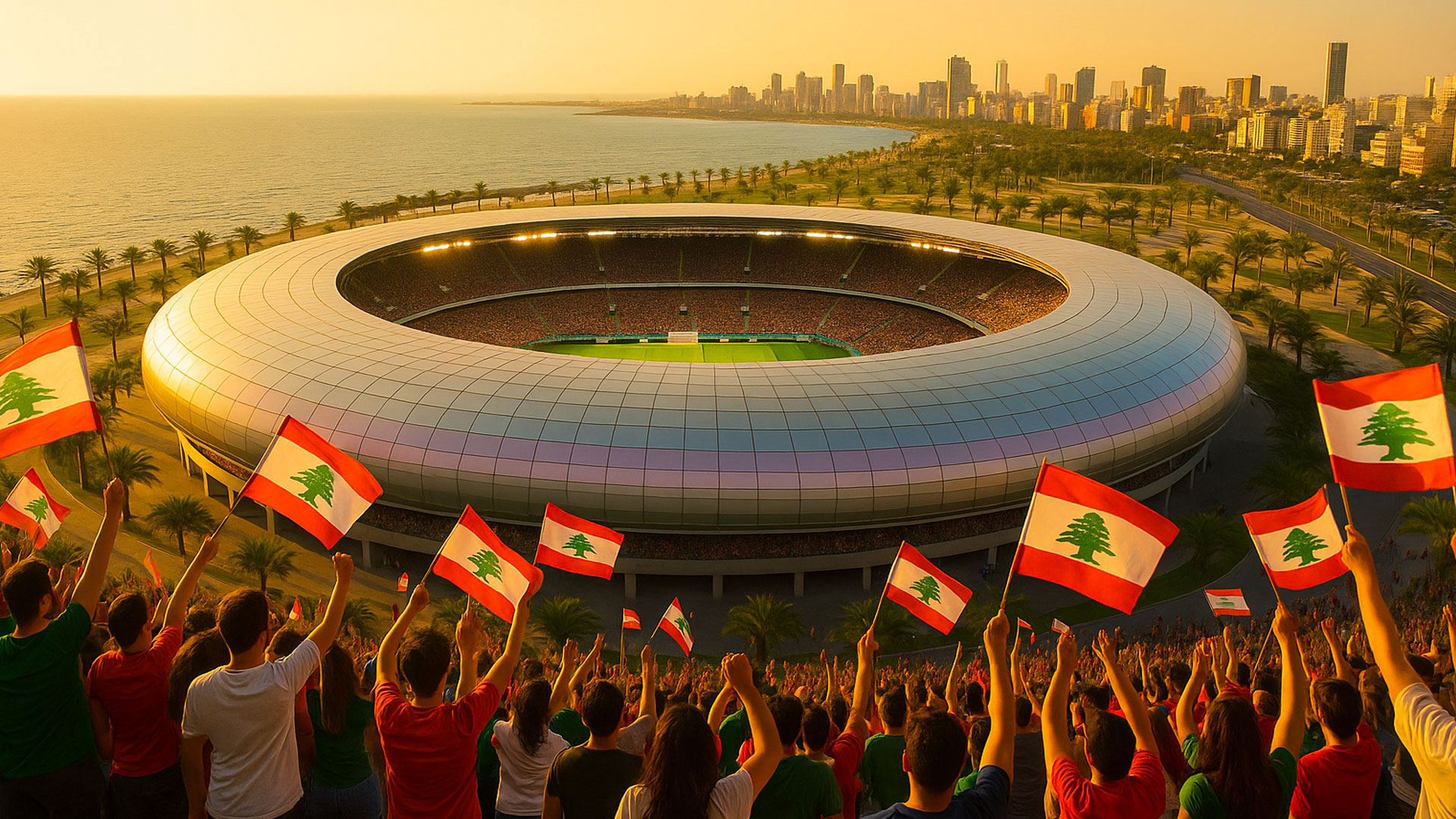
From citizenship to stadium pledge
The story began to move quickly after Infantino visited Beirut in November 2025, during which he met President Joseph Aoun and LFA president Hashem Haidar. Around the same time, Infantino revealed that he had obtained — or was in the process of formalising — Lebanese citizenship, describing the moment as both “personal and professional” and declaring, “I love Lebanon; half of me is Lebanese.”
Following that meeting, Infantino told Lebanese television and regional outlets that FIFA would work on building a state-of-the-art football stadium in Lebanon, designed to meet international standards, and offered it to the state and the LFA. Haidar, speaking to local media, said Infantino had pledged to cover all the costs of the project, a significant promise given Lebanon’s financial crisis.
Infantino framed the project not just as infrastructure, but as symbolism. A modern stadium, he argued, could become a national symbol for sport and youth, showing that Lebanon wants to move into the future “in a modern environment” after years of upheaval and decline.
What do we know about the new stadium so far?
Public details remain limited, but several key points have emerged from FIFA, Lebanese officials, and follow-up reporting by regional outlets:
- Location: The stadium is expected to be built in or near Beirut, effectively serving as a new national arena for major matches and events.
- Capacity: Infantino has spoken about a stadium for 20,000–30,000 spectators, aligning with many modern national venues in countries of similar size.
- Funding model: FIFA has pledged to fully fund the construction, meaning the Lebanese state would not be asked to finance the build, an important factor given Lebanon’s fiscal constraints.
- Ownership and use: The facility would be “offered to Lebanon and the Lebanese Football Association,” suggesting a national venue managed in coordination with the LFA for league matches, national team fixtures, and possibly concerts or large events.
At this stage, there is no publicly announced construction start date, contractor, or final site. For now, the stadium exists as a high-level commitment backed by FIFA’s leadership and welcomed by Lebanese officials.
Why a new stadium matters for Lebanese football
Lebanon’s football scene has long been defined by passionate fans and dedicated clubs playing in facilities that often lag behind regional standards. The civil war, political instability, and economic collapse have all left their mark on infrastructure. Even major grounds require constant patchwork maintenance, while training pitches and regional stadiums struggle to meet professional expectations.
A FIFA-funded national stadium could change several things:
- National team home: A consistent, international-standard venue for hosting World Cup qualifiers, Asian competitions, and regional tournaments.
- Club and cup finals: A neutral, modern arena for domestic cup finals, derbies, and regional club fixtures, helping raise matchday standards and fan experience.
- Women’s and youth football: A flagship venue for women’s national team matches, youth finals, and school tournaments, supporting the growth of the game beyond men’s senior football.
- Economic impact: Matchday jobs, hospitality, nearby businesses, and potential non-football events could bring much-needed activity to the surrounding area.
Symbolically, a modern national stadium in Beirut would signal that football — and organised sport more broadly — still has a future in a country where many young people are considering emigration.
FIFA’s wider footprint: from renovations to mini-pitches
The new stadium pledge does not come out of nowhere. Through the FIFA Forward programme, the organisation has already funded significant renovation work at existing Lebanese grounds. In 2023, FIFA reported investing around USD 1.29 million to upgrade four stadiums: Al Safa Stadium, Sin El Fil Municipal Stadium, Al Ahed Stadium, and the Zgharta Sports Complex.
These upgrades focused on improving pitches and facilities to host domestic league and cup matches, women’s and girls’ competitions, youth tournaments, and national team activities, as well as training courses for coaches and referees. The reopening of Sin El Fil Municipal Stadium after renovation in early 2023 was one visible milestone in that process.
Beyond full-size stadiums, FIFA has also discussed bringing the FIFA Arena mini-pitch project to Lebanon. The global plan aims to build 1,000 small football pitches in less privileged areas worldwide by 2031, and FIFA has indicated that Lebanon could benefit from this programme as part of a wider push to grow participation.
Big promise, big questions
Even with the excitement around a FIFA-funded football stadium in Lebanon, many questions remain unanswered:
- Where exactly will it be built? Land availability, ownership, zoning, and local politics will all play a role in site selection.
- Who will operate it? The balance between the state, the LFA, and potential private partners will shape how the venue is run and maintained.
- How will access be shared? National team, top clubs, women’s football, youth events, and non-sport uses will all compete for dates and visibility.
- Can Lebanon support it long-term? A modern stadium brings ongoing costs: maintenance, security, staffing, and technology upgrades.
In a country facing economic hardship, some will ask whether a new stadium should be a priority. Others will argue that high-quality public infrastructure — including sports facilities — can be part of rebuilding confidence, providing safe spaces for youth and showcasing the country on an international stage.
What comes next?
For now, Lebanon has something it has lacked for years: a public, on-the-record commitment from FIFA to deliver a fully funded, international-standard football stadium. Turning that pledge into concrete, steel, and green turf will require careful planning, political coordination, and transparent communication with fans.
If the project moves from promise to reality, it could become one of the most significant investments in Lebanese sports infrastructure in decades. If it stalls, it risks becoming another chapter in the country’s long list of “what might have been” stories.
Either way, the debate around the new stadium has already highlighted a deeper question: what kind of future do Lebanese people want for their game — and how can global bodies like FIFA support it without overshadowing local needs and voices?
Leave a Reply