

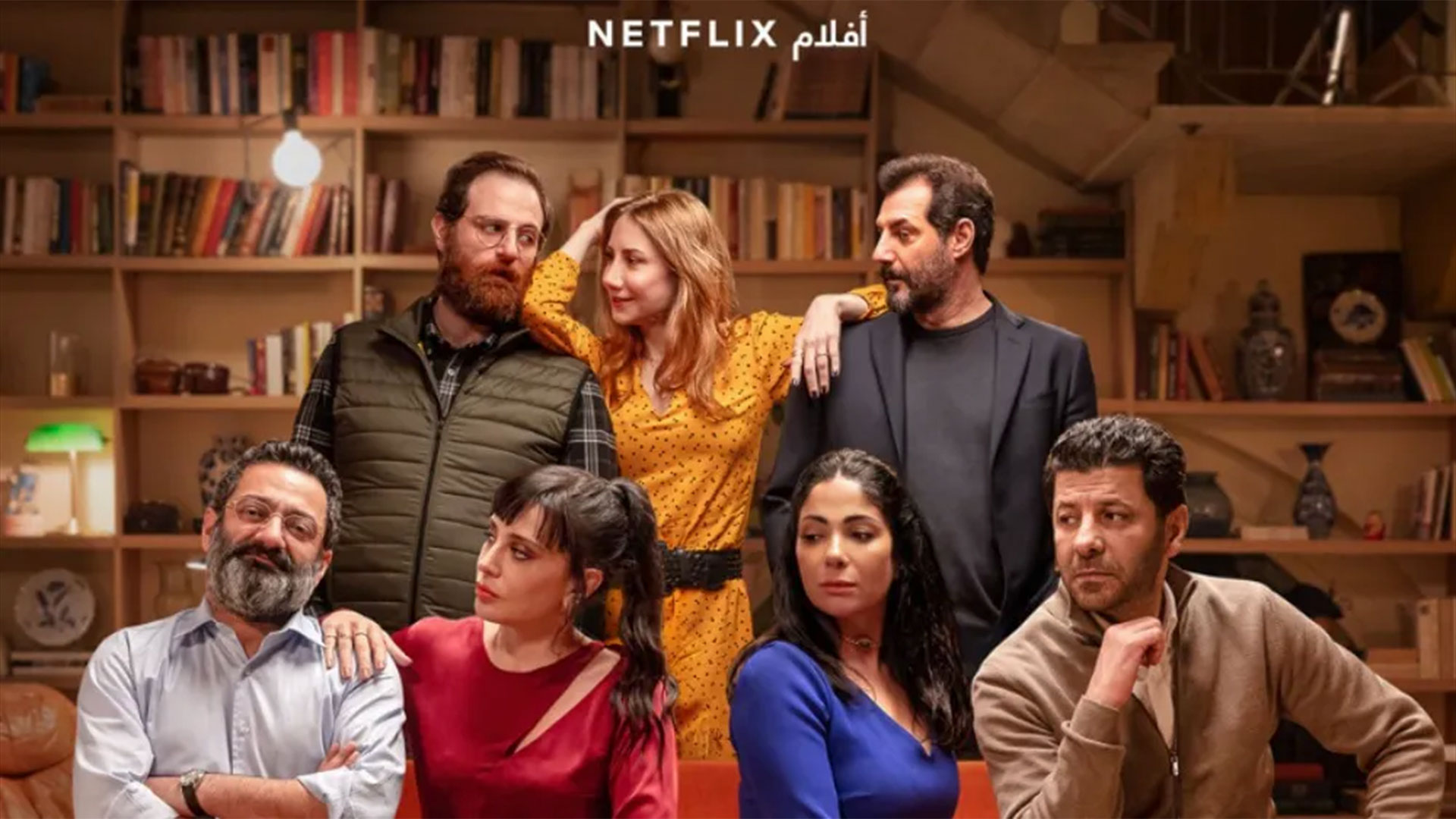
When Netflix announced an Arabic remake of the Italian hit “Perfect Strangers,” the project immediately drew attention—not only for its provocative premise, but also for its Lebanese-heavy cast and crew. The film, titled Aṣḥāb… Wala Aʿazz (“Friends… and No Dearest”), unites some of the region’s most recognizable actors around a single dinner table, where one simple game spins into chaos.
At the center stands Nadine Labaki—internationally acclaimed director of “Capernaum”—this time in front of the camera, alongside Georges Khabbaz, Adel Karam, Mona Zaki, Fouad Yammine, Diamand Abou Abboud and Eyad Nassar. Together they anchor what Netflix describes as its first Arabic-language original feature produced entirely by Arab production companies.
A Game That Turns into a Social X-ray
The story appears simple: seven close friends gather for dinner and decide to play a “transparent” game. Every incoming call, text or voice note must be shared openly with the entire table. At first, the mood is playful. But as notifications arrive, private histories collide with public personas, and the group is forced to confront jealousy, infidelity, hidden identities and carefully constructed lies.
The film mirrors the Italian original’s structure while translating its tensions into a Middle Eastern context—where questions of honor, marital expectations, sexuality and social reputation carry different weights. That shift gives Lebanese and regional audiences a version of the story that feels uncomfortably close to home.
A Milestone for Lebanese Talent on Netflix
Behind the camera, Lebanese director Wissam Smayra leads a production backed by Front Row Filmed Entertainment, Empire Entertainment, Film Clinic and Yalla Yalla, with music by Lebanese composer Khaled Mouzanar.
Netflix released the film in 190 countries, subtitled in more than 30 languages and dubbed in several others, significantly amplifying the profile of Lebanese actors who have long been household names in the Arab world but less visible to global audiences.
Controversy and Conversation
As soon as it dropped, the Arabic “Perfect Strangers” shot to the top of Netflix rankings across the MENA region and even reached the global non-English top 10, while also triggering intense debates.
Some viewers praised the film for tackling taboos around relationships, lies and LGBTQ themes in a direct way rarely seen in mainstream Arab cinema. Others accused it of violating “social values,” illustrating how a single film can expose deep divides over representation and morality.
Regardless of where audiences fell, the result was impossible to ignore: a Lebanese-anchored ensemble piece had become the center of a region-wide cultural conversation, streamed simultaneously in homes from Beirut to Paris.
Lebanon at the Center of a Regional Story
For Lebanon, this project sits at the intersection of several trends: the export of Lebanese acting talent, the rise of streaming platforms as primary distribution channels, and a new wave of Arab storytelling that refuses to skirt sensitive topics simply to avoid controversy.
With “Perfect Strangers,” Nadine Labaki and her fellow Lebanese cast members helped prove that Arabic-language films can be both locally grounded and globally visible. The dinner table may be fictional, but the tensions around it—privacy, technology and the masks people wear—could belong to any gathering in today’s hyper-connected Arab world.
Leave a Reply